
Most adults start with 1 to 2 grams of kratom powder per dose. Effects typically appear between 2 and 5 grams. Doses above 8 grams carry real risk of nausea, sedation, and dependence. There are no FDA-approved dosing guidelines, so caution is the proven approach.
- Beginner kratom doses: 1 to 2 grams per session
- Moderate doses (3 to 5g) produce stronger effects for most users
- Doses above 8 grams are high-risk and not recommended
- Kratom has no official medical dosing standard from any regulatory body [2]
- Body weight, strain type, and tolerance all shift the right amount
- Daily use builds tolerance fast and raises dependence risk
- Kratom can stay in your system 5 to 9 days depending on use frequency
- Quality comes first: contaminated or mislabeled products cause unpredictable effects
- Get expert help before combining kratom with any medication
What Is a Safe Kratom Dosage for Beginners
For first-time users, 1 to 2 grams is the safest starting point. This low dose lets the body respond without overwhelming it. Most beginners feel mild effects at this range, which is exactly the point.
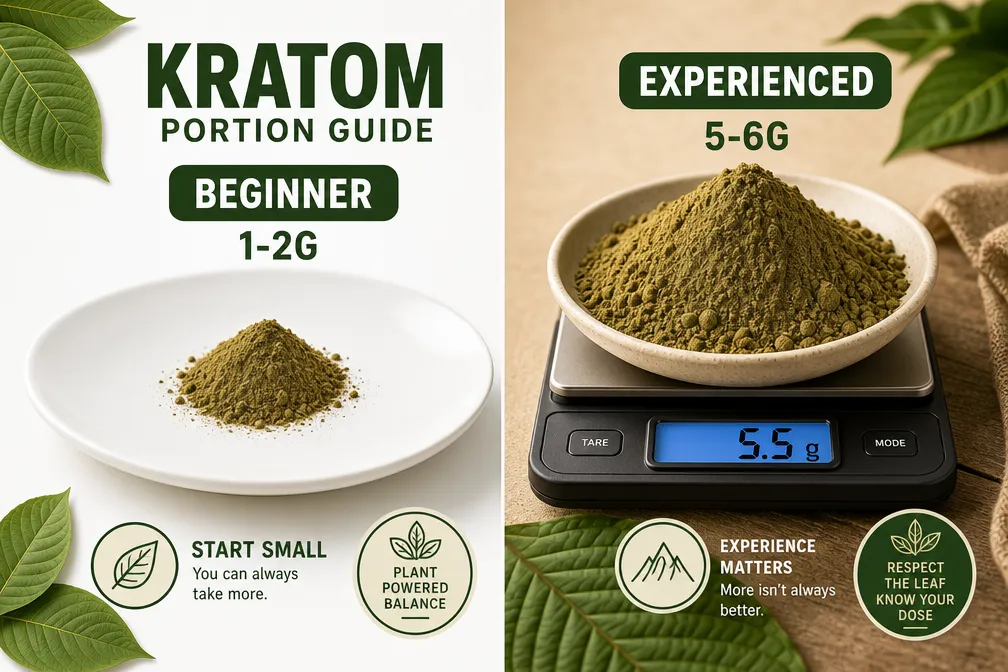
The question of how much kratom can I take has no single universal answer. Body chemistry, tolerance, and product quality all change the outcome. That said, the beginner framework is consistent across most guidance:
- Day 1: Start at 1 gram. Wait 45 minutes before considering more.
- If nothing happens: Add 0.5 grams, not a full extra dose.
- Maximum for session one: Stay under 3 grams total.
- Wait at least 24 hours before the next dose.
This approach builds trust with the substance. Skip shortcuts here. Going too high on the first try causes nausea, dizziness, and puts people off kratom entirely, or worse, masks a sensitivity that matters.
How Much Kratom Should I Take Per Dose
A functional dose for most users falls between 2 and 5 grams. Below 2 grams, effects are often too mild to notice. Above 6 grams, sedation and side effects become more likely than benefits. [8]
Here is a general dose range breakdown:
| Dose Range | Effect Profile | Risk Level |
|---|---|---|
| 1 to 2g | Mild stimulation, subtle mood lift | Low |
| 2 to 4g | Moderate energy or relaxation | Low to moderate |
| 4 to 6g | Stronger sedation or pain relief | Moderate |
| 6 to 8g | Heavy sedation, nausea risk | High |
| 8g and above | Overdose territory, serious risk | Very high |
For a more detailed breakdown of milligram-level guidance, see this proper dosage guide covering how many mg of kratom to take.
Most users land in the 2 to 5 gram range for daily functional use. That is where the balance between effect and safety holds up best. Quality comes first, though. A low-quality 3-gram dose can behave like 6 grams of clean product.
Kratom Dosage for First-Time Users
First-time users should treat the first session as a test, not a full experience. The goal is to find the threshold, not to chase an effect. How much kratom can I take safely as a newcomer depends entirely on starting low and observing.
Practical steps for a first dose:
- Use a digital scale. Eyeballing powder is not accurate enough.
- Take 1 gram on an empty stomach or lightly fed.
- Wait 30 to 45 minutes. Note how the body responds.
- If no effects appear, add 0.5 grams and wait again.
- Stop at 3 grams for the session.
- Record what was taken, when, and what happened.
This is the proven approach. It takes time, but it avoids problems that come from jumping to 5 grams on day one. For a full timing breakdown of when effects hit, check out how long kratom takes to hit.
Kratom Dosage for Pain Relief vs Energy
The dose range shifts depending on the goal. Lower doses (2 to 4g) tend toward stimulation and focus. Higher doses (4 to 6g) lean sedative and are more commonly used for pain relief. [6]
For energy and focus:
- 2 to 3 grams works for most users
- White and green vein strains perform better here
- Taking more does not increase energy. It often flips to sedation.
For pain relief:
- 4 to 6 grams is the typical range
- Red vein strains are the more common choice
- See the best kratom strains for pain relief for strain-specific guidance
Common mistake: Assuming more kratom equals more pain relief. Above 6 grams, nausea often overrides any analgesic benefit. Stronger signals do not always mean better results.
Does Kratom Dosage Depend on Strain Type
Yes, strain type affects potency and the dose needed to feel effects. A red vein strain like Red Bali behaves differently from a white vein like White Maeng Da at the same gram weight. [10]
- Red vein strains tend to be more sedating. Lower doses may be needed for the same effect.
- White vein strains are more stimulating. Users often need slightly more for sedation but less for energy.
- Green vein strains sit in the middle. They are often described as more balanced.
- Gold and yellow strains are processed differently. Potency varies more between vendors.
For strain-specific effect profiles, these guides are worth reading:
The takeaway: do not transfer a dose from one strain directly to another without adjusting down first. Quality comes first, and so does strain awareness.
Kratom Dosage by Weight: Does Body Weight Matter
Body weight has a moderate influence on kratom dosage, but it is not the only factor. As a rough estimate, lighter individuals (under 130 lbs) may feel effects at lower doses, while heavier individuals may need slightly more. However, tolerance and metabolic rate matter just as much.
A simple weight-based starting estimate:
- Under 130 lbs: Start at 1 gram, cap at 4 grams
- 130 to 180 lbs: Start at 1.5 grams, cap at 5 grams
- Over 180 lbs: Start at 2 grams, cap at 6 grams
These are estimates, not prescriptions. The FDA has not approved any dosing framework for kratom [2], so these figures come from user-reported patterns and harm reduction guidance, not clinical trials. Use them as a floor, not a target.
Can You Take Too Much Kratom
Yes. Taking too much kratom causes real harm. Nausea, vomiting, rapid heart rate, confusion, and seizures have all been reported at high doses. [1]
The question of how much kratom can I take before it becomes dangerous does not have a clean number. Individual sensitivity varies. But the risk curve rises sharply above 8 grams per dose.
Signs of taking too much kratom:
- Nausea or vomiting within 30 minutes
- Dizziness or loss of coordination
- Rapid or irregular heartbeat
- Extreme sedation or confusion
- Difficulty breathing (rare but serious)
This is a high-risk move. If any of these appear, stop dosing immediately and seek medical help. Do not wait to see if it passes.
Interactive Kratom Dose Estimator
Use this tool to get a starting dose estimate based on experience level and body weight. This is a general harm-reduction estimate only, not medical advice.
Interactive Kratom Dose Estimator
Use this tool to get a starting dose estimate based on experience level and body weight. This is a general harm-reduction estimate only, not medical advice.
Kratom Starting Dose Estimator
Estimates only. Not medical advice. Always start at the lower end.
Can You Overdose on Kratom
Kratom-related deaths have been documented, though most involve other substances. From 2020 to 2024, kratom was linked to more overdose deaths than crack cocaine was in the 1980s, according to one analysis. [9] That is a stronger signal than most people expect.
The University of Florida’s Center for the Study of Pharmacology notes that kratom’s active alkaloids, mitragynine and 7-hydroxymitragynine, act on opioid receptors. [5] That mechanism creates real overdose potential, especially when combined with other central nervous system depressants.
High-risk combinations:
- Kratom plus alcohol
- Kratom plus benzodiazepines
- Kratom plus opioids
- Kratom plus other sedatives
Get expert help before mixing kratom with any substance. This is not a gray area.
Is 10 Grams of Kratom Too Much
Yes. 10 grams is well above the range where benefits outweigh risks for most users. At this level, sedation is near-certain, nausea is common, and the risk of dependence accelerates quickly. [8]
Some long-term users report taking 10 grams or more daily. That does not make it safe. It means tolerance has built to a point where lower doses no longer work, which is itself a problem worth addressing. See the how to wean off kratom safely guide if this applies.
For anyone asking how much kratom can I take and landing on 10 grams as a target, that is the wrong direction. Do this instead: work down, not up.
How Often Can I Take Kratom Safely
Most harm reduction guidance suggests no more than 2 to 3 times per week. Daily use builds tolerance fast and raises the risk of physical dependence. [7]

The practical framework:
- Occasional use (1 to 2x per week): Low tolerance risk, effects stay consistent
- Regular use (3 to 4x per week): Tolerance begins building within weeks
- Daily use: Dependence risk rises significantly within 1 to 3 months [3]
Spacing doses at least 48 hours apart helps preserve sensitivity. This works over time. It is not exciting advice, but it avoids the tolerance trap that forces doses higher.
What Happens If You Take Kratom Every Day
Daily kratom use leads to tolerance, dependence, and withdrawal symptoms when stopped. This is well-documented in both research and user reports. [6]
Common effects of daily kratom use over time:
- Doses stop working at the same level
- Users increase amounts to get the same effect
- Stopping causes muscle aches, irritability, insomnia, and cravings
- Some users develop liver stress with prolonged heavy use [5]
This is not a scare tactic. These are documented patterns. The question of how much kratom can I take daily is less useful than asking whether daily use is the right approach at all.
For those concerned about dependence timeline, this guide on how long it takes to get addicted to kratom covers the research directly.
Kratom Tolerance and Dosage Adjustment
Tolerance is the main reason kratom doses creep upward over time. Once it starts, it builds faster than most users expect. [3]
Signs tolerance is developing:
- The same dose produces weaker effects
- Effects wear off sooner than before
- The urge to redose within the same day increases
What to do instead of increasing the dose:
- Take a break of at least 5 to 7 days
- Rotate strains to prevent receptor fatigue
- Drop back to the lowest effective dose after the break
- Do not increase by more than 0.5 grams at a time
Do not increase kratom dose over time as a default response. That path leads to dependence, not better results. Focus on fundamentals: lower doses, less frequent use, better quality product.
How Long Does Kratom Stay in Your System
Kratom’s primary alkaloid, mitragynine, has a half-life estimated between 9 and 24 hours. Full clearance from the system can take 5 to 9 days for regular users. [5]
Factors that extend detection time:
- Frequency of use (daily users clear it slower)
- Higher body fat percentage
- Older age and slower metabolism
- Kidney or liver impairment
For a detailed breakdown of kratom’s duration in the body, see how long kratom lasts in your system.
This matters for dosing because residual alkaloids from a previous dose affect how the next dose feels. Stacking doses without accounting for this is a common mistake that leads to accidental over-consumption.
Do I Need to Increase My Kratom Dose Over Time
No. Needing to increase the dose is a sign of tolerance, not a normal progression. If the current dose stops working, the answer is a break, not a higher number. [3]
This is where many users go wrong. The assumption is that more is better. It is not. Kratom works over time when doses stay low and use stays infrequent. Chasing effects by increasing grams is a high-risk move with a predictable endpoint.
The proven approach:
- Keep doses at the lowest effective level
- Take regular breaks (5 to 7 days every month)
- Rotate strains every 2 to 3 weeks
- Track doses in writing, not from memory
How Much Kratom Can I Take – FAQs
1. How much kratom can I take?
There is no single amount that works for everyone because individual responses can vary based on body size, experience, and product strength. Many beginners choose to start with a small amount and wait long enough before considering more. Reading the product label and avoiding frequent use may help reduce unnecessary risks.
2. What factors affect how much kratom someone may take?
- Body weight and individual sensitivity.
- Previous experience with kratom.
- The strain, product type, and potency.
- Whether it is taken with food or on an empty stomach.
- The serving information provided by the manufacturer.
3. Should beginners start with a small amount of kratom?
Yes. Beginners commonly start with a lower amount because it allows them to understand how their body responds before considering any changes. Increasing too quickly can make it difficult to judge individual effects. Waiting several hours before taking more is generally considered a cautious approach.
4. Can taking more kratom increase the chance of unwanted effects?
- Higher amounts may be more difficult for some people to tolerate.
- Individual reactions can become less predictable.
- Using larger servings more often may increase the likelihood of unwanted effects.
- Following product directions and avoiding unnecessary increases is generally recommended.
5. How long should I wait before taking another serving of kratom?
Responses can vary from person to person, so there is no universal waiting period. Many people choose to wait several hours before deciding whether another serving is appropriate. Taking additional amounts too soon may make it harder to understand how the first serving affected them.
6. Does the type of kratom product change how much I should take?
- Powders, capsules, extracts, and teas may differ in strength.
- Serving sizes can vary between manufacturers.
- Always check the product label before use.
- Avoid assuming different products contain the same potency.
7. Is there a standard daily limit for kratom?
There is no universally accepted daily limit because products and individual responses differ. Manufacturer guidance may vary, and scientific research continues to develop. Using the smallest practical amount, avoiding frequent increases, and following label instructions can help support more informed and cautious use.
Conclusion
The question of how much kratom can I take does not have a single clean answer. What the evidence does support is a clear framework: start low, go slow, and avoid daily use.
Kratom is not a substance with approved dosing guidelines from any health authority [2]. That means users carry the responsibility for their own safety. The best protection is accurate information, conservative dosing, and honest self-monitoring. Skip shortcuts. Follow guidance. Avoid problems before they start.
References
[1] Mortality – https://kratomregulatoryreview.org/mortality.html
[2] FDA and Kratom – https://www.fda.gov/news-events/public-health-focus/fda-and-kratom
[3] How To Dose Kratom Safely – https://kovelabs.com/pages/how-to-dose-kratom-safely
[5] Kratom – https://csp.pharmacy.ufl.edu/research/kratom/
[6] PMC8924421 – https://pmc.ncbi.nlm.nih.gov/articles/PMC8924421/
[7] Kratom Safety Tips – https://uskratom.us.com/blog/posts/kratom-safety-tips.html
[8] Kratom Dosage – https://elearning.aljazeera.net/sites/default/files/lectures/user/2025-12/kratom_dosage.pdf
[9] Friday Fact: From 2020 To 2024 Kratom Was Linked To More Overdose Deaths Than Crack Cocaine Was In The 1980s – https://thedrugreport.org/2026/06/04/friday-fact-from-2020-to-2024-kratom-was-linked-to-more-overdose-deaths-than-crack-cocaine-was-in-the-1980s/
[10] Kratom Dosage Guide – https://www.marcotran.com/sites/default/files/2025-12/kratom_dosage_guide.pdf
Lauren is a researcher and writer who enjoys uncovering the cultural and historical aspects of plant use. With a background in anthropology and a love for storytelling, she focuses on presenting thoughtful content that connects past wisdom with present-day perspectives. Lauren believes that sharing these stories fosters greater appreciation for nature’s role in human life. Her work is centered on curiosity, respect for cultural traditions, and a passion for learning from the natural world.
Matthew is an observer of how plants influence traditions, rituals, and everyday practices across different cultures. His fascination lies in the way knowledge is passed down through generations and how it continues to shape communities today. Matthew brings a reflective tone to his writing, combining research with an appreciation for cultural heritage. His goal is to inspire readers to look beyond the ordinary and see plants as part of a broader human story.


